Tuesday, August 17, 2021

Autumn in August engages in some Persuasion


Thank you all for attending yet another discussion of Autumn in August, where our attention now turns to Jane Austen and her final completed work, Persuasion.

While there have been other adaptations of this classic novel(as of this writing, two more are being filmed), I have a particular fondness for the 1995 film as it is the reason that I started reading Jane Austen in the first place.

Back when the movie debuted in US theaters, the critical acclaim for it made me interested in reading the book(and later seeing the film on home video) which then lead to more and more engagement with Austen's literary world. I guess you could say it imprinted Austen on me.

Persuasion is unlike most of Austen's work as it's leading lady Anne Eliot(Amanda Root) is not the usual young girl searching for love heroine. Rather, she's a woman in her late twenties, considered "out of bloom" by the standards of the day who lives with her vain widowed father Sir Walter(Corin Redgrave) and her equally awful older sister Elizabeth(Phoebe Nicholls).

Since Sir Walter and Elizabeth insist upon living above their means-"A barnonet must be seen to live like a baronet!"-the only recourse to save the family from out and out financial disgrace is to move to the city of Bath and rent out their estate to a fresh from the Napoleonic wars well off Navy man, Admiral Croft(John Woodvine) and his wife. 

As it happens , that admiral is related by marriage to a former love interest of Anne's, Captain Frederick Wentworth(Ciaran Hinds).

Wentworth and Anne fell in love several years ago, intending to marry if not for the persuasion of Lady Russell(Susan Fleetwood), a family friend who gives motherly advice to all of the Eliots but to Anne especially. 

With Sir Walter and Elizabeth only tolerating her at best(and treating her like a servant at worse), it's not surprising that Anne at 19 was willing to listen to Lady Russell at the time.

However, upon hearing that Wentworth might be back in her life, Anne has found that the decision she made back then perhaps wasn't the best one for her own happiness:


Anne is sent to stay with her married younger sister Mary Musgrove(Sophie Thompson), who always "fancies herself ill" and is a great complainer when things don't go her way.

With the Musgroves being way nicer people, Anne is happy to be at their homestead of Uppercross for now. Also, she hopes to avoid being in Wentworth's company even though his brother-in-law and sister (Fiona Shaw, who is a real delight along side Woodvine) are completely lovely folks to be around.

Wentworth does eventually make friends with the Musgroves-the daughters of the house are very happy to know him!-and meet up with Anne again. They are awkwardly polite for the most part, unsure of each other's true feelings. 

However, on more than one occasion, it does appear that Wentworth, despite his attentions to one Musgrove girl, still has some regard for Anne there:


Before Anne rejoins her father and sister in Bath, an incident on a trip to the seaside town of Lyme Regis causes both Wentworth and Anne to wonder about their potential future together.

Upon reuniting in Bath, things are still uncertain between them as Anne is now being courted by her formerly estranged cousin Mr. Eliot (Samuel West).

Is Anne meant to marry Mr. Eliot and perhaps save her family estate or is this the time to truly follow her heart?

This film is so well done with director Roger Michell bringing such a natural setting and tone to the story. The characters look and feel like actual people instead of fancy dress up figures. 

The script by Nick Dear also drops a few references to the wider world with the now ending war against Napoleon(and possibly starting up again!) and the changes in social class with the now enriched military veterans.  

As some Austen fans know, the original book had more than one ending planned and Dear was able to nicely incorporate that extra material seemlessly into the screenplay.

Best of all is the chemistry between Root and Hinds, who are subtle yet strong when the plot needs them to be:


That subtle energy comes in handy when Anne finds out how Wentworth really feels, thanks to a letter that is the most romantic declaration ever written in my humble opinion!:


While I do look forward to seeing the newer adaptations of Persuasion, this version will always hold a special place in my literary heart.

Please join us next time for our fall finale feature, You’ve Got Mail.  I know that there’s plenty of mixed emotions about this movie but I think we can find a good common ground that doesn’t involve fighting over caviar garnish:


Monday, August 09, 2021

Autumn in August enters The Age of Innocence


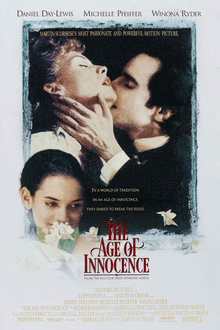
Welcome back for our second presentation in the LRG summer series, Autumn in August, where we look at another Edith Wharton adaptation, the 1993 Martin Scorsese helmed film ,The Age of Innocence.

Set during the Gilded Age in New York, our leading man here is Newland Archer(Daniel Day-Lewis), who is about to marry into another well connected family with May Welland(Winona Ryder) and couldn't be happier or so it seems.

When May's cousin, Countess Ellen Olenska(Michelle Pfeiffer) arrives in town, her reputation for scandal threatens  the insular social order of their world. Newland does what he can to smooth the ruffled feathers but finds it hard pressed to blame Ellen for making what turned out to be a bad marriage for her.

When assigned to Ellen's divorce case by his law firm, Newland has to tell her the realities of New York society("Everything is labeled but everyone is not") and while he does succeed in persuading her to hold off on the divorce, Newland fervently wishes that she was free to be with him:


Newland does marry May yet even after a year's separation, finds that his passion for Ellen has not died down. Rather, it has increased and those feelings are shared by her.

With Ellen back in his social circle, he makes many excuses to be alone with her but their intimacy is never truly consummated. Despite the pain they might cause to both themselves and others, Ellen and Newland find it hard to resist taking that next step:


As Newland makes plans with Ellen, he soon discovers that his secret is not as secret as he thinks. Sooner than he expected, Newland realizes that this momentous decision in his life is not his alone to make.

Before I talk about the overall look of the film, I must make the case for May Welland. Repeatedly throughout the film, she is described as a shallow and rather unintelligent person, “ a curtain drawn over an emptiness.”

Granted, she’s doesn’t take an interest in things outside of her personal realm but May is not at all stupid. She knows full well Newland has doubts before and after their marriage and doesn’t hesitate to use what emotional weapons she has in her arsenal to get what she wants.

If anything, she’s more honest than he is when it comes to their relationship. Also, there’s no malice about her actions or intentions. May is just doing what a woman of her status was taught to do and she does it elegantly:


Scorsese spared no expense when it came to making this film as lush looking as possible. From the art on the walls to the table settings at a casual meal, the jewel box tones of this era highlight the hidden codes and hints of such a vicious circle of people.

The story itself is just as lovingly designed, with a wonderful cast that includes Richard E. Grant, Olivia Dukakis and Miriam Margolyes as Mrs. Manson Mingott aka "the dowager empress of New York society"-she is such a joy to watch! A special casting bonus is the narration that pops in at just the right moments, done by the late great Joanne Woodward, the perfect cap off to this feast of a film:


Please join us next time as we venture into Jane Austen country with 1995's Persuasion, the movie that got me reading Austen's work in the first place. I know that there are other versions with very fine qualities about them(which I have enjoyed) but I measure all of those against this one:


Monday, August 02, 2021

Autumn in August visits The House of Mirth


Welcome to the premiere of the LRG end of summer salute that is Autumn in August, where films that invoke the feel of those impending cold weather months are showcased for discussion.

Our first feature presentation is the 2000 adaptation of Edith Wharton's The House of Mirth which stars Gillian Anderson as Lily Bart, a New York socialite in the late 19th century who is starting to age out of the marriage market.

Lily is lovely and charming enough to land a suitably rich husband yet she doesn't have much of a follow through mode when a target is in her sights. 

The one man that does truly captivate her heart and mind is Lawrence Selden(Eric Stolz), a well to do lawyer who admires Lily yet is not in the marrying for social advancement game-part of that is due to having affairs with married women but we'll get to that soon enough!

Before I get back to the plot, it must be said that the chemistry between Anderson and Stolz in these roles is a low hum of electric tension, which is precisely what such characters need to have on screen. Many of the casting choices in this film are excellent but the key parts were most important for this particular story and very well done indeed:


Part of  Lily's problem is that most of of her friends are superficial at best and self serving at the worst. 

While there are a few who wish her well such as social hanger-on Carry Fisher(Elizabeth McGovern), most of the women in her social circle are either overly judgemental like her Aunt Julia(Eleanor Bron) or false faced such as the quietly scheming cousin Grace Stepney(Jodhi May) who "reluctantly" tells her aunt of Lily's various misdeeds.

Those misdeeds come from Lily misunderstanding what it means when the husband of one of her good friends, Gus Trenor(Dan Ackroyd, who plays pompous entitlement extremely well here) offers to help her "invest" some money in order to pay her ever increasing bills. Turns out she takes him at his literal word and actually believes saying "thank you" is proper enough but as Gus says, "When a fellow pays for dinner, he's usually given a seat at the table." *shudder*

 There's also Simon Rosedale(Anthony LaPaglia), a social climber who is honest enough about his intentions towards Lily but can't stand by her when things get rough. Worst of all of them is Bertha Dorset(Laura Linney) who hates her husband enough to openly cheat on him yet begrudges a former lover like Selden to being with anyone else, especially Lily. She's quite the frenemy from hell and as all of these forces gather about Lily to do her in, Selden is slow to stop her social downward spiral:


The deeply cut irony of all of this is that Lily Bart truly has principles. Yes, she makes many mistakes but when time and again, it is pointed out to her that by enacting a moral compromise or two, her situation can improve, Lily says no.

That does seem naive of her yet it's also honorable. As time goes on, Lily refuses to be on the level of her detractors such as Bertha(who she does have solid evidence of her adultery in the form of letters on) and regardless, she doesn't want to gain her social salvation in such an underhanded manner.

Granted, some of that reluctance is due to Selden's prior involvement with Bertha, however when push comes to shove, Lily would rather swallow the bitter pills that Bertha forces upon her in public than become as nasty as her former friend is:


The House of Mirth is not a happy tale to tell but it is beautifully told nonetheless. Writer/director Terence Davies does create visually appealing outdoor scenes yet it's those inside sections of the story that are the most memorable. If you enjoy elegant dialogue in ornate rooms, this is the movie for you!

What really seals the deal is that at times, the movie feels like a stage play and yes, that is a compliment. Lily's journey is one of those quietly brutal dramas that would make for a gripping Broadway production and it's chief mode of decoration is the emotional intensity that swirls up when least expected.

The strongest connective thread is the relationship between Lily and Selden, which is done to perfection by both actors no matter what setting they happen to be in. If you haven't seen THOM, I fully recommend it as it does the book justice while giving the story a few unique touches of it's own:


I do hope that you all enjoyed this first outing of Autumn in August and please do join us next time for more Edith Wharton entertainment as Martin Scorsese gives his operatic take on The Age of Innocence-popcorn is always welcome!: